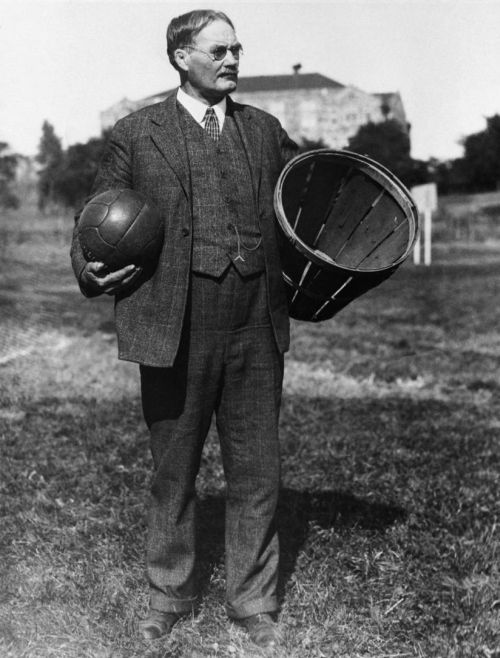
In this game and in early subsequent games, when a basket was scored, a custodian with a ladder had to remove the ball from the solid-bottomed peach basket. In the following years, an unaltered peach basket would be replaced with a peach basket with holes in the bottom (in which the ball would be popped out with a long rod), an unripped net, a net contraption that opened with a lever (similar to a modern-day toilet), and finally with empty-bottomed nets. Despite the seemingly alien differences between Naismith’s invention and contemporary basketball, there were some striking similarities. As indicated in Naismith’s original 13 rules, “no shouldering, holding, pushing, tripping, or striking in any way the person of an opponent shall be allowed,” which is basically the policy regarding fouls in modern basketball. Also, “if there was evident intent to injure the person [during a foul], [the offending player would be removed] for the whole of the game,” which is comparable to the modern NBA’s Flagrant-2 policy. There was even the 5-second violation on inbound passes, which served then, as it does now, to quicken the game’s pace of play.
Soon after the first privately held game at the YMCA, members of the Springfield community began to come out and watch the regularly-held matches played in the YMCA gymnasium. Basketball then began to spread like wildfire, jumping from YMCA to YMCA, from town to town, from college to college and from state to state, where many of the original members of the YMCA International Training School brought it when returning home on their school breaks. In 1893, less than two years after the sport was invented, Mel Ride-out organized the first match on foreign soil in France, and in the following decades the U.S. military was instrumental in spreading the game as it roamed the globe. While the first intercollegiate basketball match occurred between Hamline University and Minnesota State on February 9, 1895, it is not officially recognized as such because it still utilized Naismith’s original nine-to- a-side guidelines. The first college basketball game that did incorporate the modern five-to- a-side limitations took place between the University of Iowa and the University of Chicago on January 18, 1896, when Chicago squeaked by Iowa 15-12.
Soon after, in 1898, the first professional basketball league was formed. The National Basketball League, characterized by six teams from the Northeast (New York Wanderers, Trenton Nationals, Millville Glass Blowers, Bristol Pile Drivers, Camden Skeeters, and Pennsylvania Bicycle Club) was an early precursor to the American Basketball League (founded 1925), the Basketball Association of America (founded 1946), and the largest and longest-lasting of them all, the National Basketball Association (founded 1946). While it folded after six truncated seasons, the NBL, along with colleges, YMCA, and the organic spread of the game, helped to raise the national profile of basketball. As a fun side note, the original copy of Dr. James Naismith’s 13 Rules sold for $4.3 million in 2010. The Naismith Memorial Basketball Hall of Fame, opened in 1959, is located in the game’s original birthplace of Springfield, Massachusetts.